AC/DC Calc
power supply concepts
How to Choose an AC to DC Power Supply for a Defined Load
Match DC voltage, continuous and peak current, input range, derating, isolation, and protection to the actual requirements of your equipment.
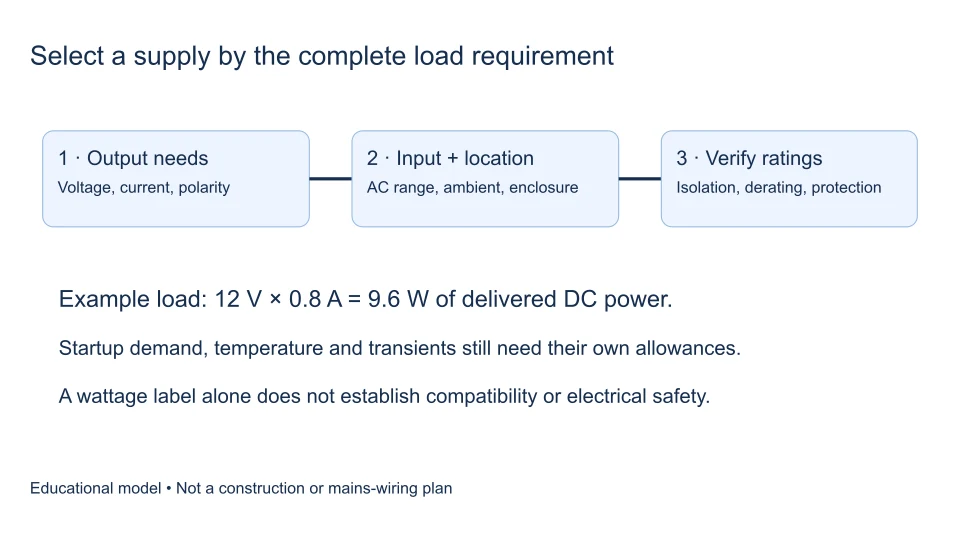
Choose an AC-to-DC power supply by starting with the load’s documented requirements, not with a familiar connector or a voltage guessed from the AC input. The correct output voltage, suitable current capability, polarity, operating environment, and protection behavior all matter. A supply that passes one of those checks may still be unsuitable overall.
This guide explains a selection process rather than recommending products or describing mains wiring. An adapter for consumer equipment, an enclosed industrial supply, a battery charger, and an LED driver can have very different interfaces and control requirements. The equipment documentation and the selected supply’s datasheet remain the deciding references.
First identify what kind of output the load expects
Determine whether the load needs constant voltage, constant current, or a managed charging or negotiation process. Most ordinary DC-powered electronic equipment specifies a voltage range and draws current according to its operation. An LED string may require controlled current. A battery needs a charging system appropriate to its chemistry, configuration, and protection arrangement.
A matching voltage label does not establish compatibility between those categories. USB-powered equipment may also require a supported connector and negotiation protocol before a particular voltage or power level is available. Do not infer a battery-charging function or USB capability from the words “DC power supply.”
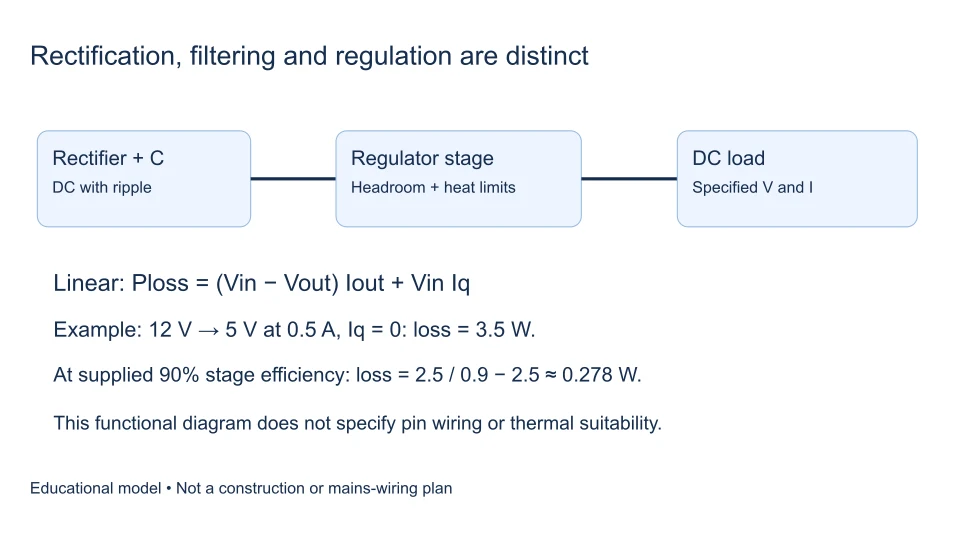
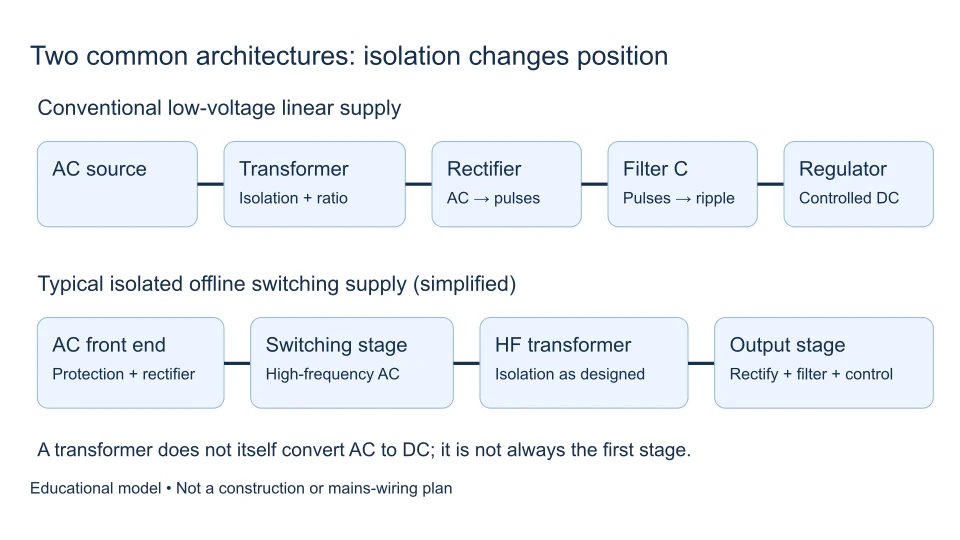
For the underlying circuit distinction, read unregulated versus regulated supplies. The conversion-stages guide shows why rectification alone does not establish a controlled output.
Match voltage, tolerance, and polarity
Use the equipment’s specified operating voltage and allowed range. A nominal label such as 12 V does not tell you how much deviation the load tolerates. Include output accuracy, load regulation, line regulation, ripple, startup overshoot, and voltage drop in connecting conductors when evaluating the voltage delivered to the equipment.
Common labels describe different supply families rather than interchangeable choices:
| Nominal DC level | Questions that remain after matching the number |
|---|---|
| 5 V | Is this a fixed DC input or a USB interface with additional requirements? |
| 9 V | What polarity, connector dimensions, tolerance, and current does the equipment specify? |
| 12 V | Is the load regulated electronics, a motor, lighting, or a charging system? |
| 24 V | What startup current, control-interface limits, and installation conditions apply? |
| 48 V | What exact voltage range, isolation, connector, and applicable system requirements are specified? |
Polarity must match as well as voltage. Connector shape does not guarantee the same center-pin polarity, pin assignment, current rating, or mechanical fit. Do not treat nominal voltage as a substitute for the equipment manual.
Separate continuous current from temporary demand
A current rating states capability under specified conditions. It does not mean a constant-voltage supply forces that current through every connected load. A compatible load normally determines its operating current; the supply must support the required continuous current and any permitted transient demand while maintaining an acceptable output.
Measure or obtain the demand across relevant modes: standby, normal operation, startup, actuation, and simultaneous use of accessories. A motor starting, an amplifier reproducing a peak, and a circuit charging its input capacitance can place different demands on a supply with the same nominal continuous load.
Extra current capability does not make an incorrect voltage safe. Nor does a higher headline wattage guarantee acceptable response to a short load pulse. Check the manufacturer’s overload mode, response limits, and allowed peak-load duration rather than assuming all supplies tolerate the same surge.
Calculate power without losing the current constraint
For a DC output, output power is Vout × Iout. A 12 V load drawing 2 A continuously requires 24 W at that operating point. If it also draws 3 A for a defined startup interval, the demand during that interval is 36 W. A supply must meet both the continuous condition and a suitable startup requirement.
Suppose a hypothetical 12 V, 3 A supply is rated for 36 W under its stated reference conditions. If its documented operating-temperature curve permits only 80% of that output at the actual ambient condition, the available continuous power becomes 28.8 W, or 2.4 A at 12 V. That exceeds the example’s 2 A continuous demand but does not, by itself, validate the 3 A startup event.
This example illustrates how to read ratings; the 80% figure is an assumed datasheet condition, not a general derating rule. A manufacturer’s particular rating, curve, and peak specification must replace each assumed value.
Apply the actual derating conditions
Ambient temperature, ventilation, mounting orientation, enclosure temperature, altitude, and input voltage can affect usable output. A fan-cooled rating may not apply with the fan absent. A supply assessed in free air may need a different operating limit inside a warm enclosure beside other heat sources.
MEAN WELL’s installation-manual collection provides application instructions by supply family. Its technical FAQ discusses model-dependent conditions including mounting orientation, output behavior, and input selection. Use the specific product documentation rather than transplanting guidance from an unrelated model.
Keep current and thermal margins tied to identified uncertainties. A margin intended for startup demand does not replace temperature derating. A conservative power budget cannot compensate for an incompatible connector or missing isolation requirement.
Check input range and the installation category
A supply’s AC input range must cover the intended source conditions. “Universal input” must be confirmed from the actual specifications. Some supplies have input-selection arrangements; others are intended for a defined voltage range or phase configuration. Do not assume a selector position or internal arrangement from appearance.
Match the supply type to the equipment and setting. A user-accessible external adapter differs from an open-frame module intended for incorporation by a qualified equipment designer. Exposed terminals, earthing arrangements, enclosure protection, clearance, and applicable approvals require their own assessment.
The MEAN WELL selection method identifies output requirements, input and phase requirements, and system-level features as distinct selection decisions. None is replaced by a rectifier-voltage calculation.
Read protection behavior as an operating specification
Overcurrent, short-circuit, overvoltage, and overtemperature protection have different purposes. Their presence does not guarantee that a particular load will start or remain safe under every fault. A supply can enter current limiting, periodically retry, shut down until power is cycled, or use another documented behavior.
If a load repeatedly starts and stops, investigate whether its startup demand and the supply’s protection behavior interact. Increasing the rating without understanding that interaction may conceal the underlying mismatch. Check whether the load also needs reverse-polarity protection, transient suppression, or a controlled shutdown.
Protection inside a power supply does not eliminate the need for appropriate system protection. Correct conductor ratings, connectors, fusing, enclosure design, and installation remain separate responsibilities.
Evaluate ripple and noise at the relevant point
A supply’s ripple and noise specification depends on its measurement method and operating conditions. It should not be compared casually with a calculated low-frequency capacitor ripple value. Switching-frequency noise, line-frequency variation, transients, and measurement artifacts can affect sensitive circuits differently.
The guide to measuring rectifier output explains why a meter average and a waveform measurement answer different questions. For a reservoir-capacitor estimate, use the smoothing-capacitor calculation guide while keeping its assumptions visible.
Our AC-to-DC calculator estimates defined circuit models. It does not certify supply compatibility, establish available current from voltage alone, or substitute for the selected equipment’s specifications.
Questions before making the final selection
Can a higher-current adapter replace the original?
Possibly, if voltage, polarity, connector, regulation, interface, protection, and applicable requirements also match. A higher current rating alone is neither a compatibility guarantee nor a reason to use a higher voltage.
Is 30% extra power always the right margin?
No universal percentage covers all loads and environments. A manufacturer’s recommendation can be a useful starting point within its context, but check continuous demand, documented derating, startup or pulse behavior, and the actual installation separately.
Can AC input voltage tell me the DC current available?
No. Current capability depends on the entire supply and its operating limits. See why AC voltage does not determine DC current for the missing information.
Record the chosen voltage range, current profile, power budget, environmental conditions, interface, and protection requirements before choosing a supply. That short specification is more useful than comparing wattage labels without a defined load.
Filed under power supply concepts