power supply concepts
How to Choose an AC to DC Power Supply for a Defined Load
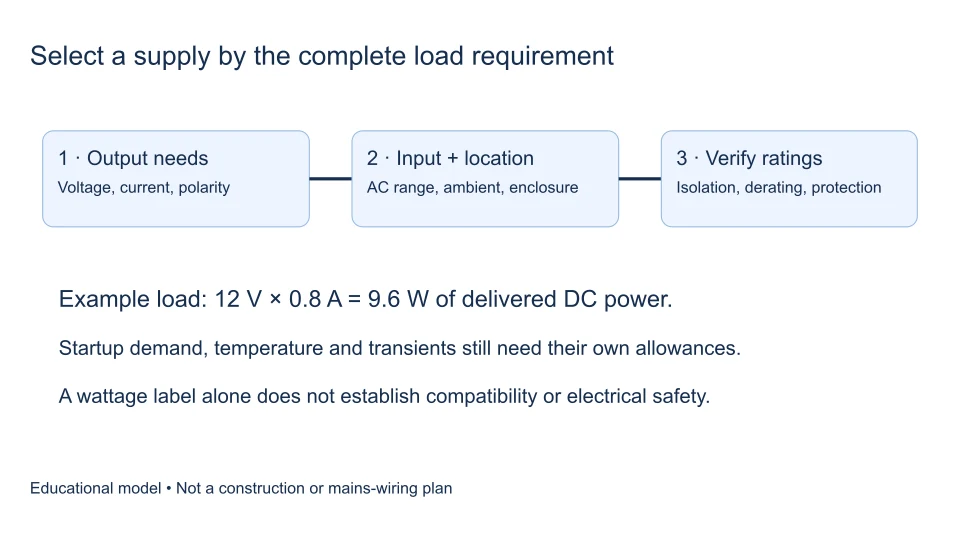
Match DC voltage, continuous and peak current, input range, derating, isolation, and protection to the actual requirements of your equipment.
 AC/DC Calc. A little more clarity.
Practical guides to the models behind a rectifier calculation.
Match DC voltage, continuous and peak current, input range, derating, isolation, and protection to the actual requirements of your equipment.
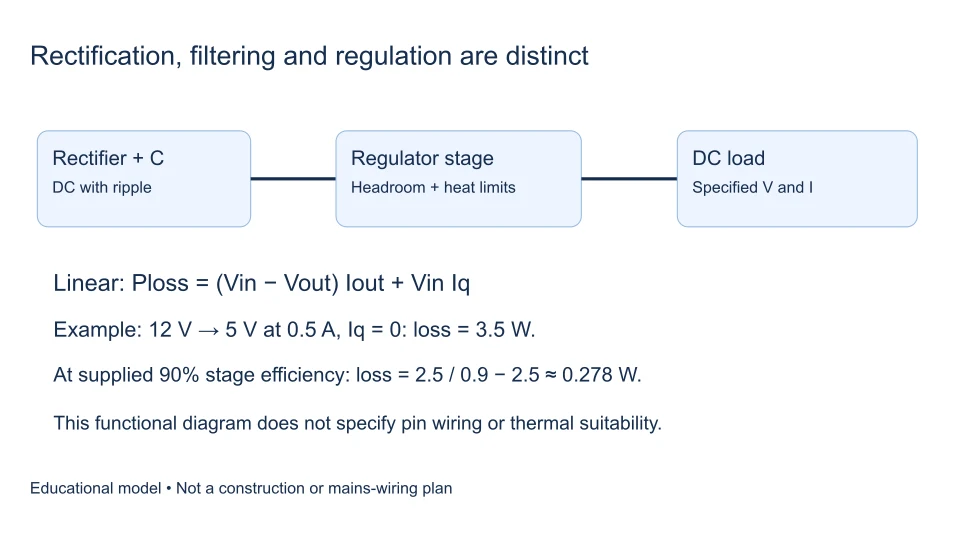
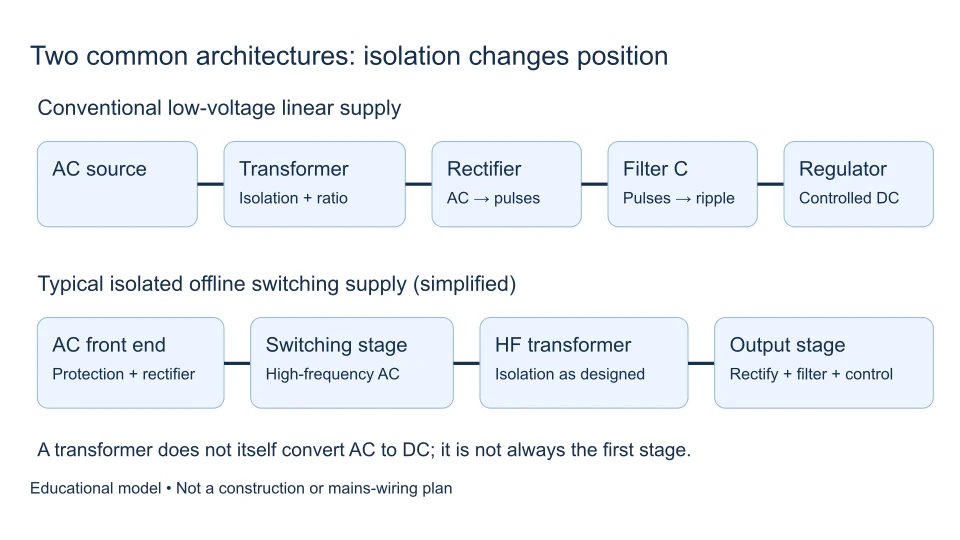
Compare conventional linear and switching supplies by conversion stages, regulation, heat, ripple, efficiency, and the needs of the actual load.
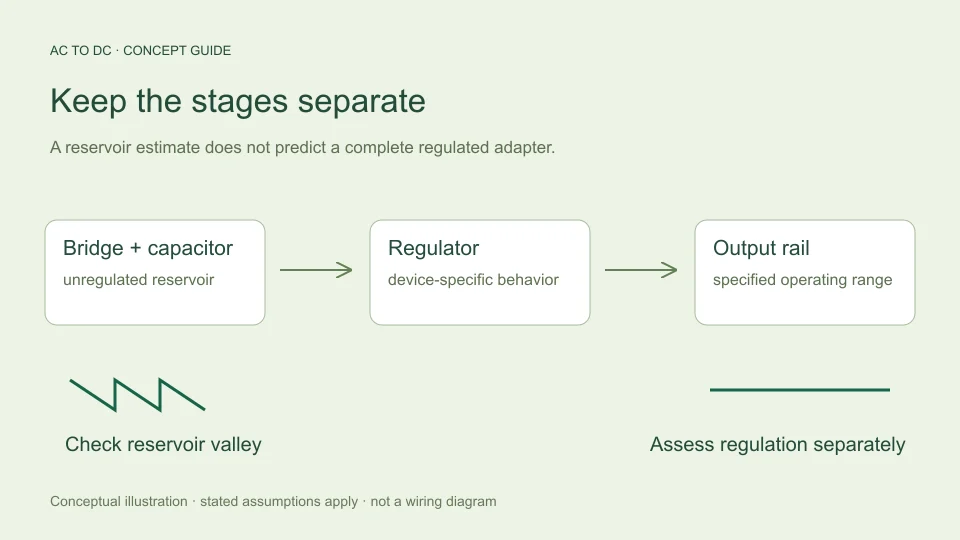
Follow the signal through a conventional transformer supply and an isolated switching supply, and see why rectification alone is not regulation.
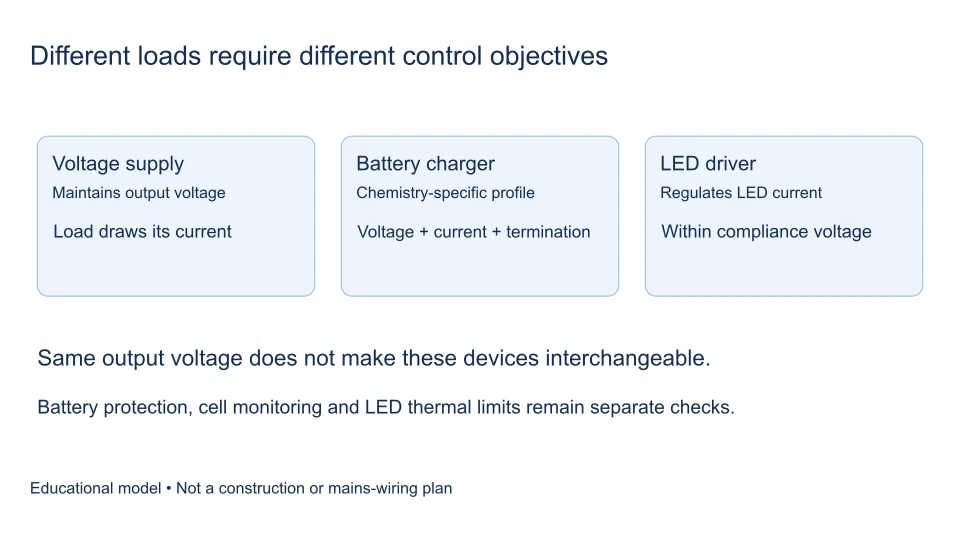
Understand why a DC voltage supply, chemistry-specific battery charger, and constant-current LED driver need different control and protection.
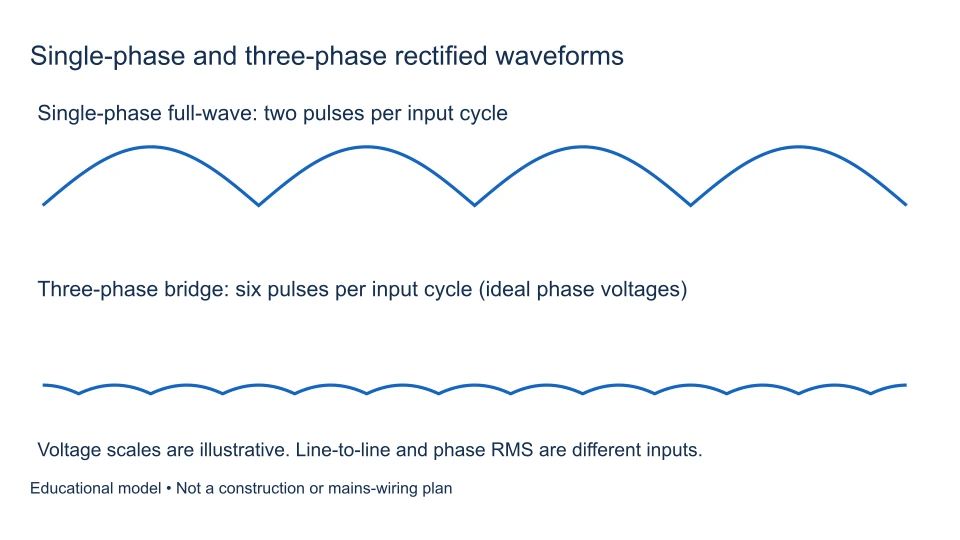
Compare bridge topology, line-to-line input voltage, six-pulse timing, capacitor charging, and the assumptions behind three-phase output estimates.
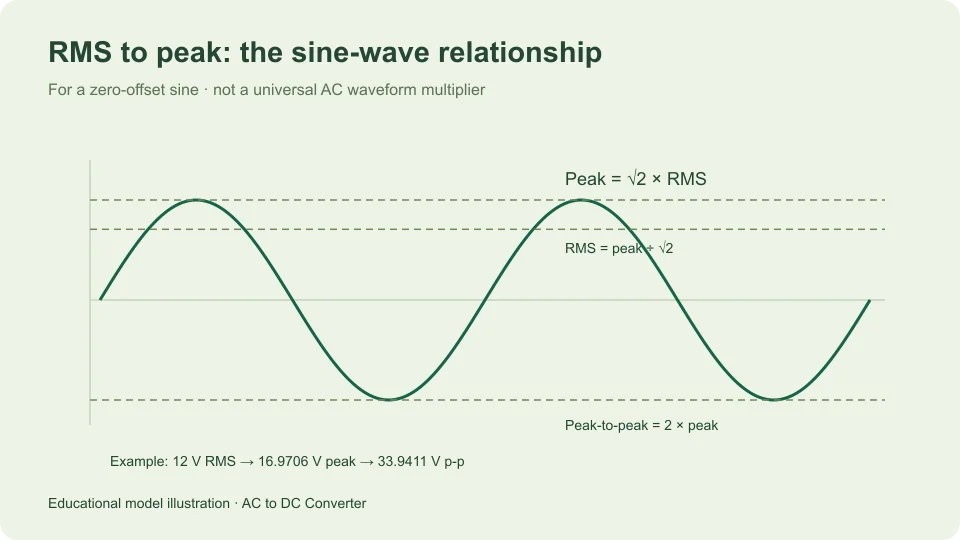
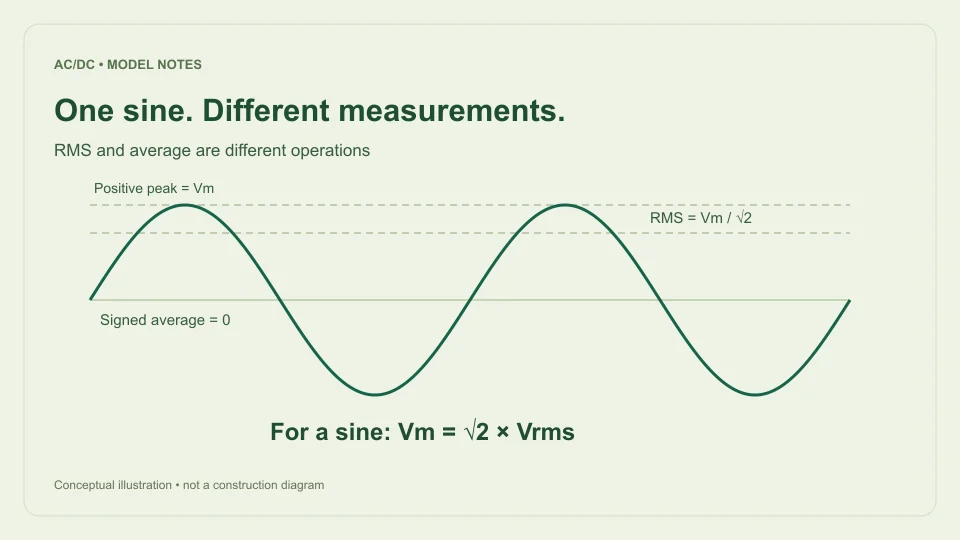
Understand the square-root-of-two factor, its waveform assumption, and how peak voltage enters a rectifier model.
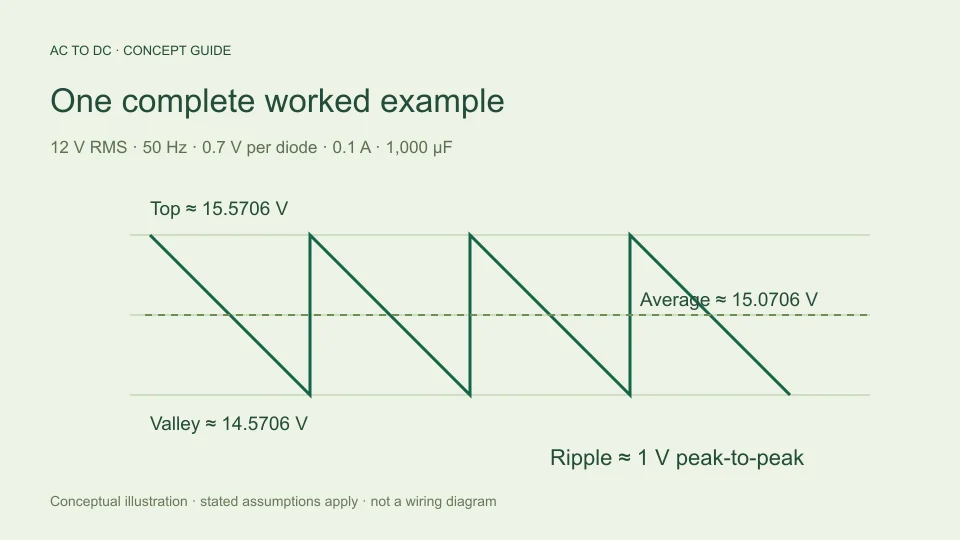
Follow complete numerical examples for filtered and ideal rectifier models, including a rejected high-ripple case.
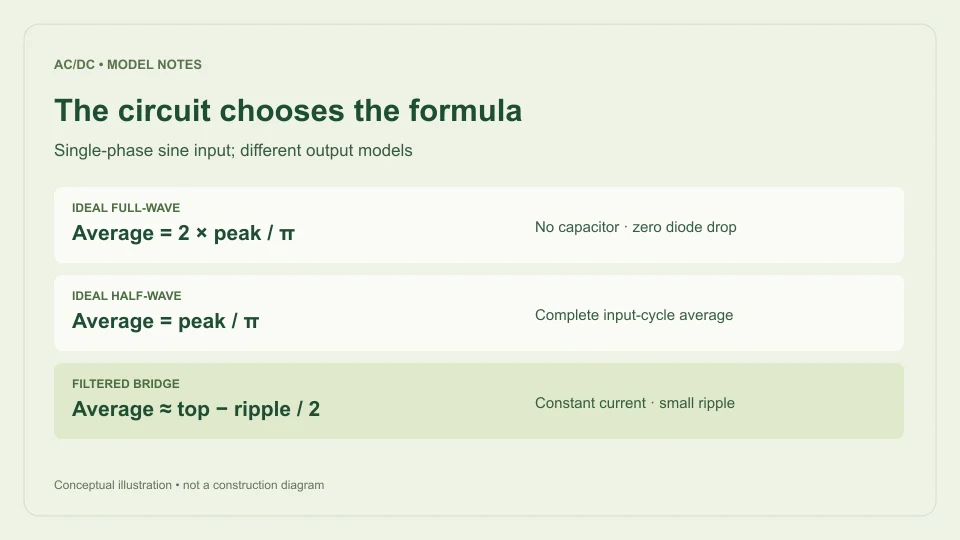
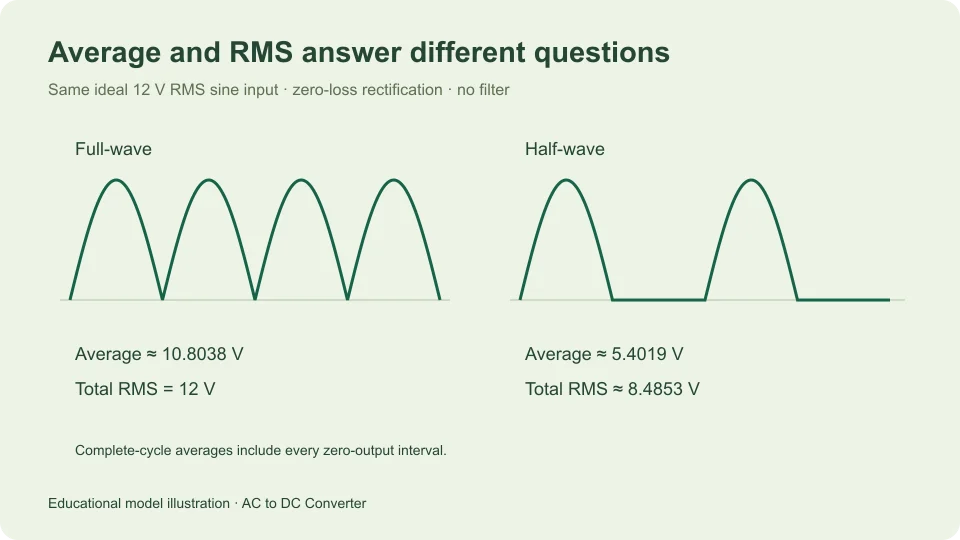
Compare ideal rectifier averages and capacitor-filtered bridge estimates using clear assumptions and worked examples.
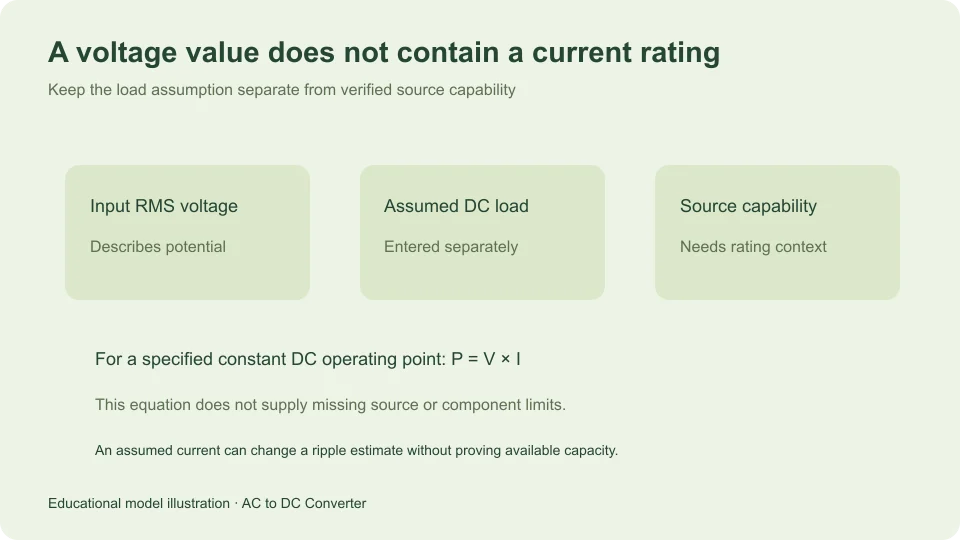
Separate output voltage estimates from load current, transformer capacity, power, and component stress.
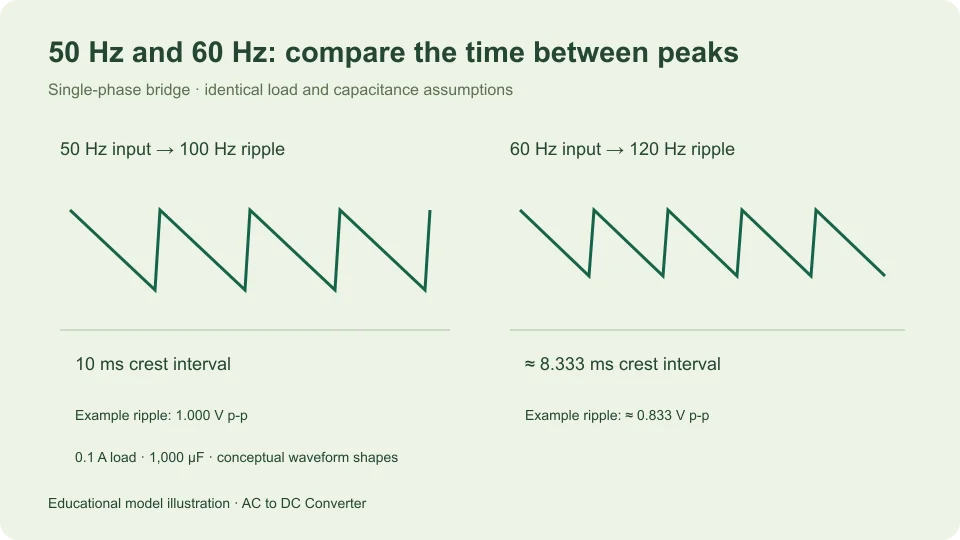
Compare charging intervals, ripple frequency, and simplified capacitor ripple while holding the other inputs constant.
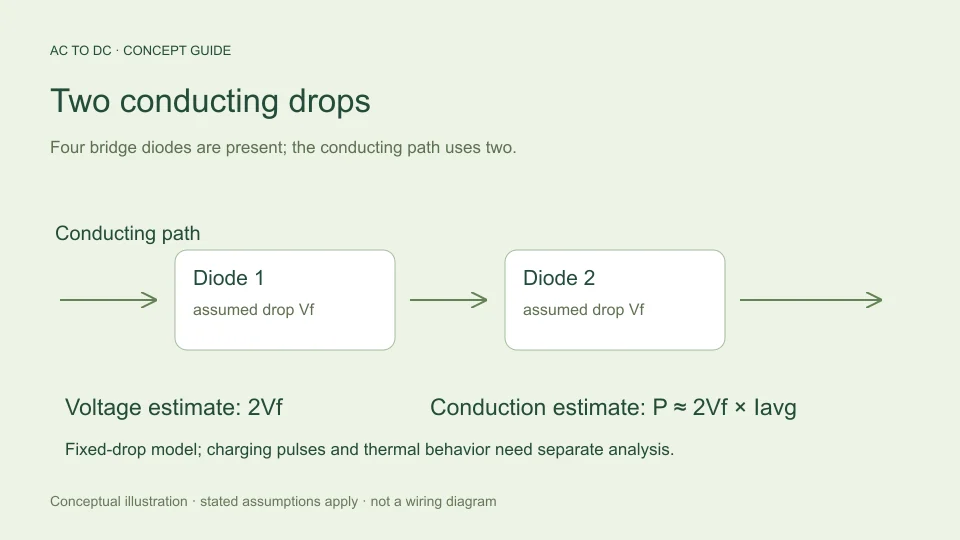
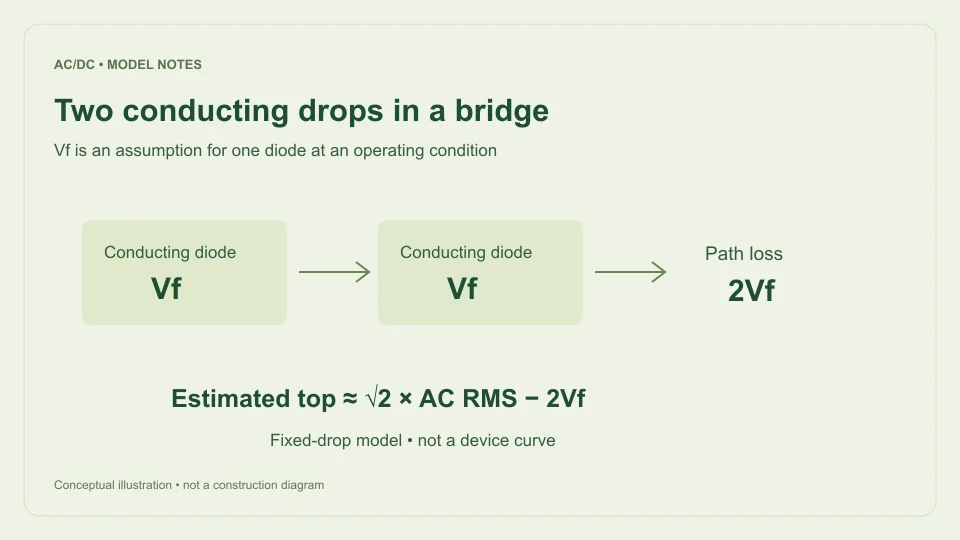
Understand the useful 2Vf voltage model and why it does not replace current-waveform or thermal analysis.
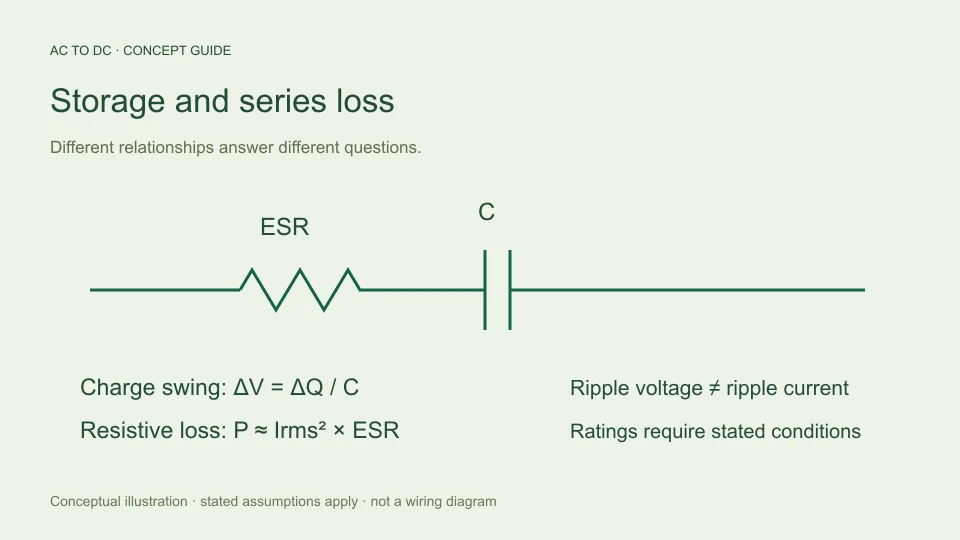
Separate charge-storage ripple from resistive voltage changes and ripple-current heating.
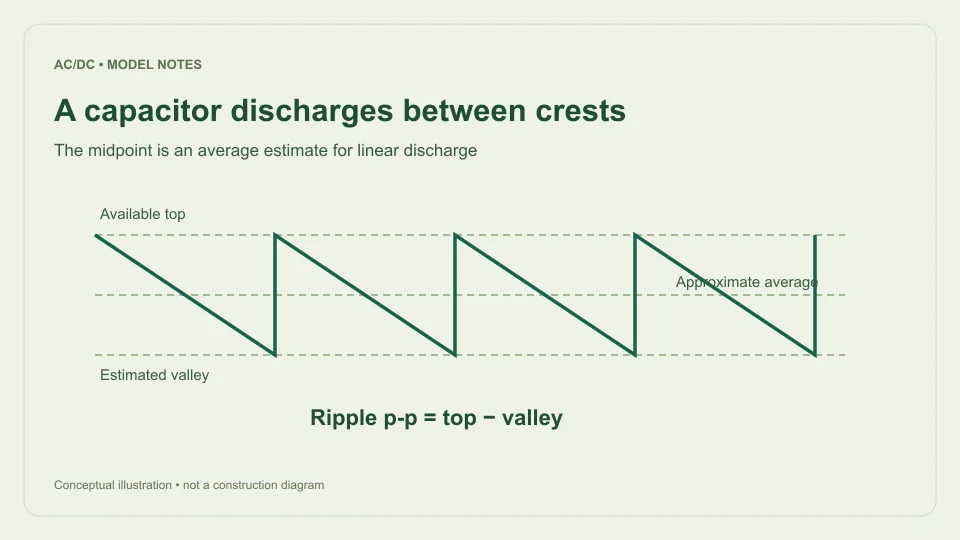
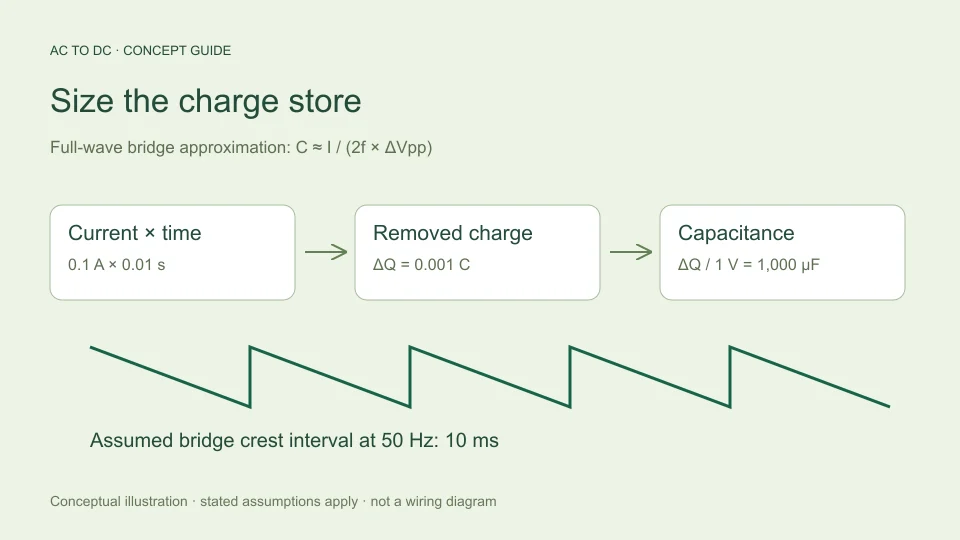
Derive bridge ripple from charge balance, work through units, and understand where the small-ripple approximation stops being useful.
Understand per-diode versus bridge drop, current and temperature dependence, and the limitations of a fixed-drop rectifier estimate.
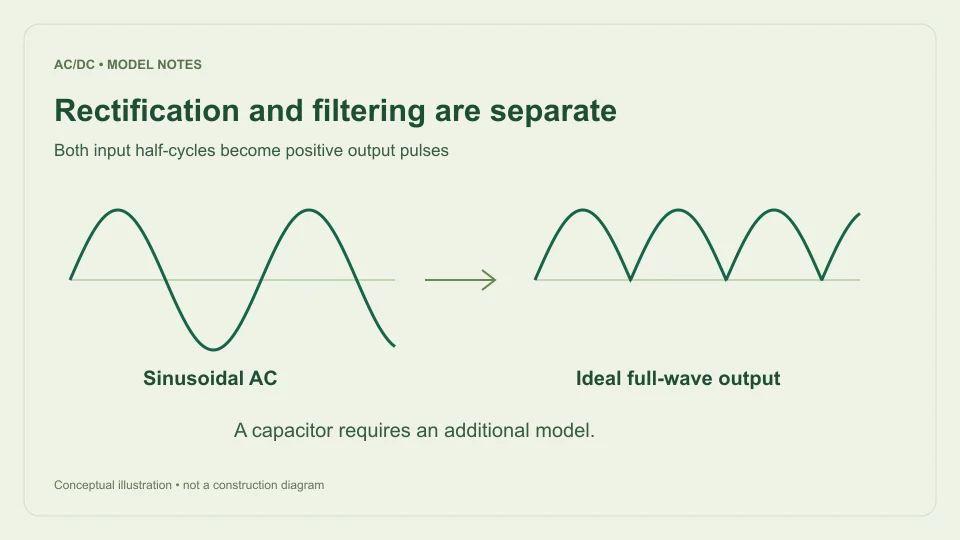
Understand what a bridge changes, why two diode drops appear, and how its ideal average differs from a capacitor-filtered estimate.
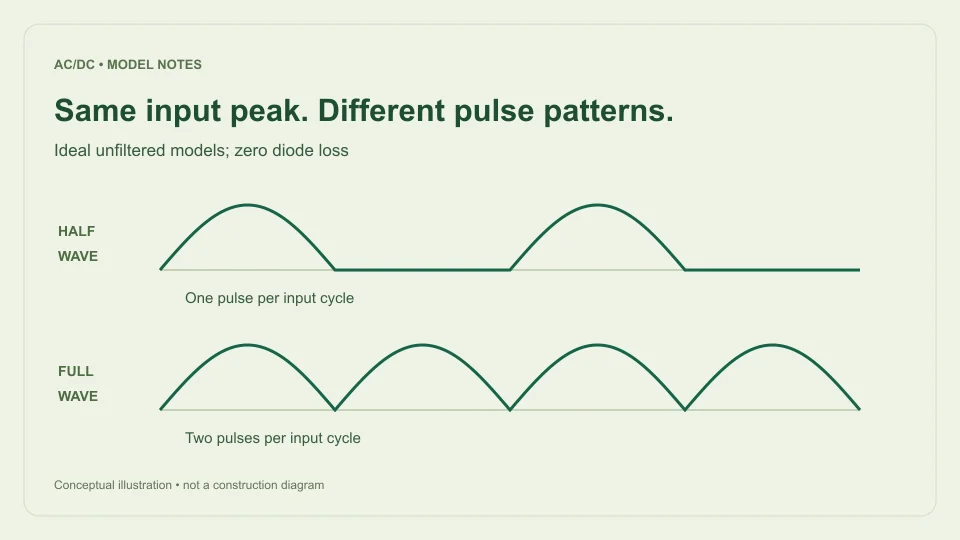
Compare complete-cycle averages, peaks, RMS values, pulse timing, and filtering assumptions without mixing different circuit models.
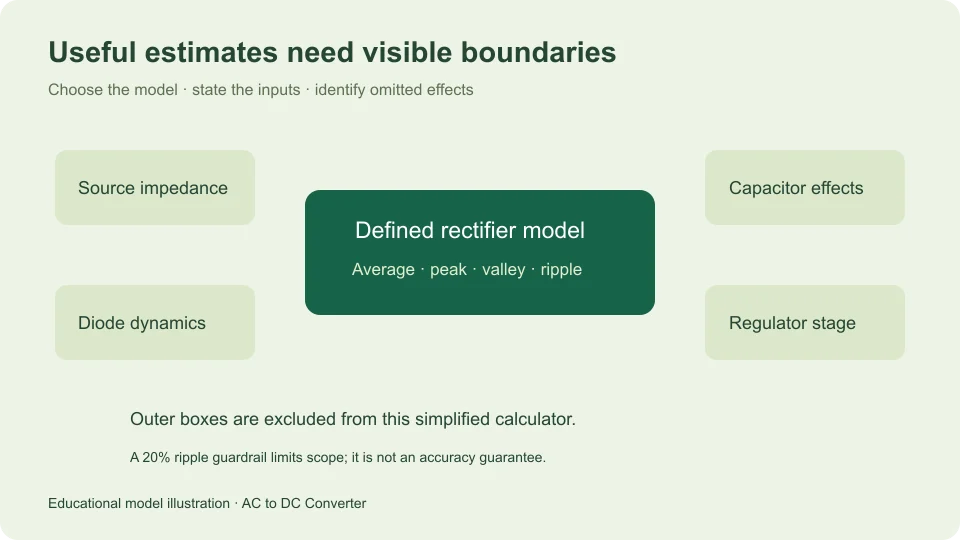
Learn which questions a rectifier estimate can answer, what its assumptions omit, and when the calculation needs a fuller model.
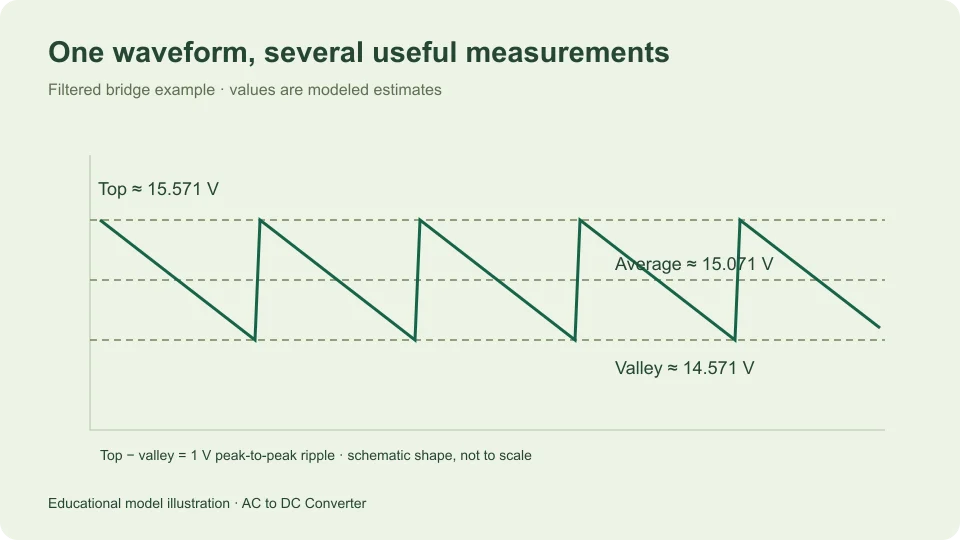
Interpret DC average, ripple, peak, and RMS readings without confusing one measurement with another.
Derive why a rectified waveform can have one average, another RMS value, and a separate ripple component.
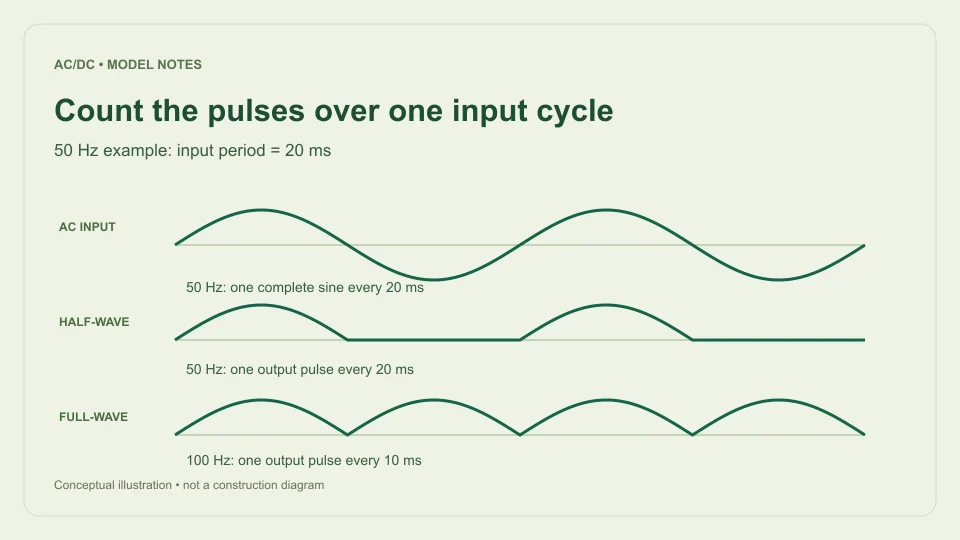
Separate AC input frequency, rectified pulse repetition, ripple magnitude, and waveform harmonics using timing diagrams and worked examples.
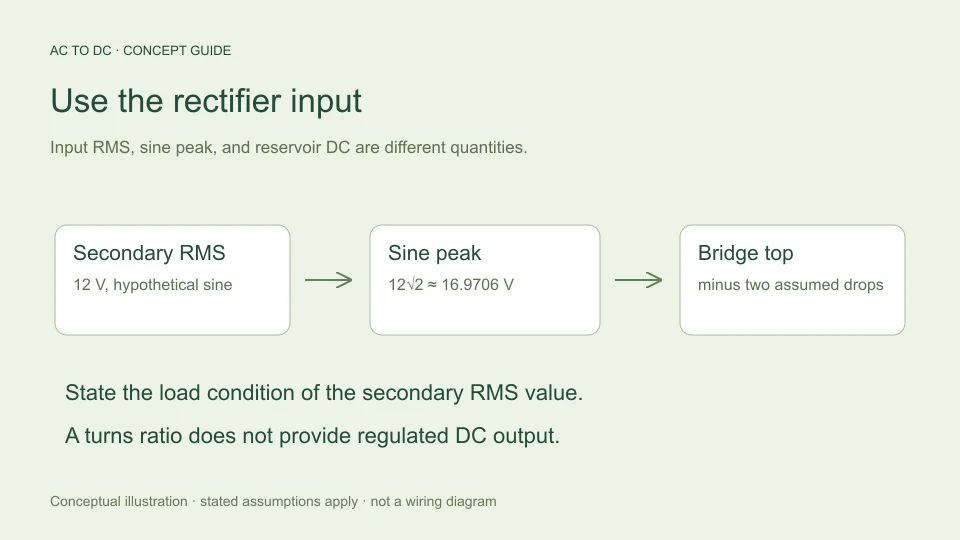
Distinguish sine-wave RMS, peak, signed average, rectified average, and filtered estimates before calculating AC to DC output.
Derive a useful capacitance estimate without mistaking it for a complete component selection.
Interpret secondary RMS voltage, waveform peaks, and regulation before estimating rectifier output.
Understand why a rectifier estimate is not a prediction of an adapter or regulated output.
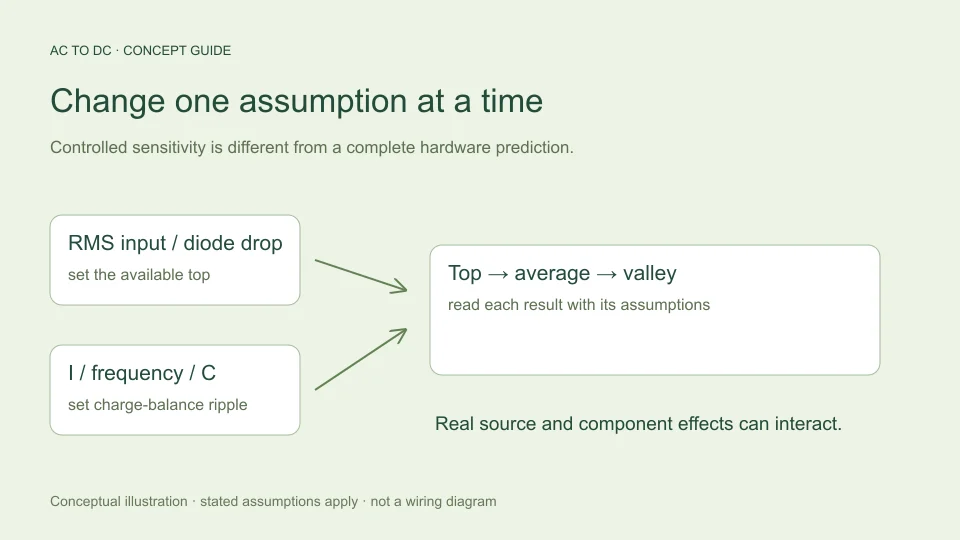
Use controlled comparisons to distinguish arithmetic changes from effects outside a simplified rectifier model.